Moxibustion (Moxa)
Moxibustion is the practice of using Moxa, primarily dried mugwort, to treat deficiencies of the body. These deficiencies lead to the development of a variety of conditions that can go unchecked and result in excesses elsewhere.
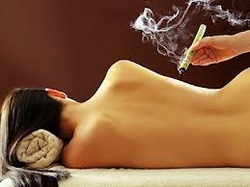
The Moxa is used in several different ways. One way is indirect Moxa where the Moxa is formed into a cigar shaped cylinder that is lit at one end. The Moxa does not maintain a flame, instead it's lit until it smolders. Then the Moxa is held and moved in circular patterns above specific Acupuncture points on the body. The patient only feels the warmth coming from the smoldering Moxa. The movement and warmth of the Moxa above the points stimulate the movement of Qi and blood through the meridians that the Acupuncture points lie on to encourage a smoother flow.
The use of Moxa is especially effective for the treatment of chronic problems and condition, such as weaknesses and deficient conditions often associated with elder people. When a patient is considered too weak for Acupuncture, because needling might move Qi too quickly or aggressively for a weakened person, Moxibustion is said to help add new energy to the person's body allowing treatment of both excess and deficient conditions. The warming effects of Moxa help combat cold and dampness in the body that result from some of these deficient conditions.
Another use of Moxa is the combination of Moxa and Acupuncture needling. For some conditions a "ball" of Moxa is formed and placed onto the handle of an Acupuncture needle that has been placed into a point on the body. This use of Moxa warms the needle as well as the point below where the needle is inserted, giving the treatment a double dose of stimulations using both the warmth of the Moxa and Qi movement of the needle.
The Moxa is used in several different ways. One way is indirect Moxa where the Moxa is formed into a cigar shaped cylinder that is lit at one end. The Moxa does not maintain a flame, instead it's lit until it smolders. Then the Moxa is held and moved in circular patterns above specific Acupuncture points on the body. The patient only feels the warmth coming from the smoldering Moxa. The movement and warmth of the Moxa above the points stimulate the movement of Qi and blood through the meridians that the Acupuncture points lie on to encourage a smoother flow.
The use of Moxa is especially effective for the treatment of chronic problems and condition, such as weaknesses and deficient conditions often associated with elder people. When a patient is considered too weak for Acupuncture, because needling might move Qi too quickly or aggressively for a weakened person, Moxibustion is said to help add new energy to the person's body allowing treatment of both excess and deficient conditions. The warming effects of Moxa help combat cold and dampness in the body that result from some of these deficient conditions.
Another use of Moxa is the combination of Moxa and Acupuncture needling. For some conditions a "ball" of Moxa is formed and placed onto the handle of an Acupuncture needle that has been placed into a point on the body. This use of Moxa warms the needle as well as the point below where the needle is inserted, giving the treatment a double dose of stimulations using both the warmth of the Moxa and Qi movement of the needle.
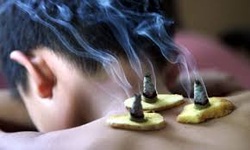
Moxa can also be used directly on top of certain herbs that are placed on the body above selected Acupuncture points to address specific conditions. The Moxa is pressed and shaped into cones and placed on top of the herb. Then it is lit, usually with a stick of incense, until it begins to smolder. The lit Moxa will smolder for several minutes until it burns out. During that time the practitioner may move the herb with the Moxa on it to several locations or simply leave it there until your treatment is over.
Some of the herbs that might be used beneath the Moxa may be Fu Zi (Aconite Root), Ginger, Garlic or even Salt, depending on the practitioner's intended use. Ginger, for example, used under Moxa works very well for conditions of diarrhea when placed on the abdomen at Acupuncture points near the belly button. It is even believed, in Chinese Medicine, that the use of Moxa can be used to help turn breeched babies. A 2012 Cochrane Collaboration review stated that there is "some evidence" that the use of Moxibustion could be useful for reducing the need for external cephalic version, where the breeched baby is maneuvered into proper position by pushing and pressing onto the mothers abdomen. (Coyle ME, Smith CA, Peat B (2012). "Cephalic version by moxibustion for breech presentation". In Coyle, Meaghan E. Cochrane Database Syst Rev 5: CD003928.)
Some of the herbs that might be used beneath the Moxa may be Fu Zi (Aconite Root), Ginger, Garlic or even Salt, depending on the practitioner's intended use. Ginger, for example, used under Moxa works very well for conditions of diarrhea when placed on the abdomen at Acupuncture points near the belly button. It is even believed, in Chinese Medicine, that the use of Moxa can be used to help turn breeched babies. A 2012 Cochrane Collaboration review stated that there is "some evidence" that the use of Moxibustion could be useful for reducing the need for external cephalic version, where the breeched baby is maneuvered into proper position by pushing and pressing onto the mothers abdomen. (Coyle ME, Smith CA, Peat B (2012). "Cephalic version by moxibustion for breech presentation". In Coyle, Meaghan E. Cochrane Database Syst Rev 5: CD003928.)